
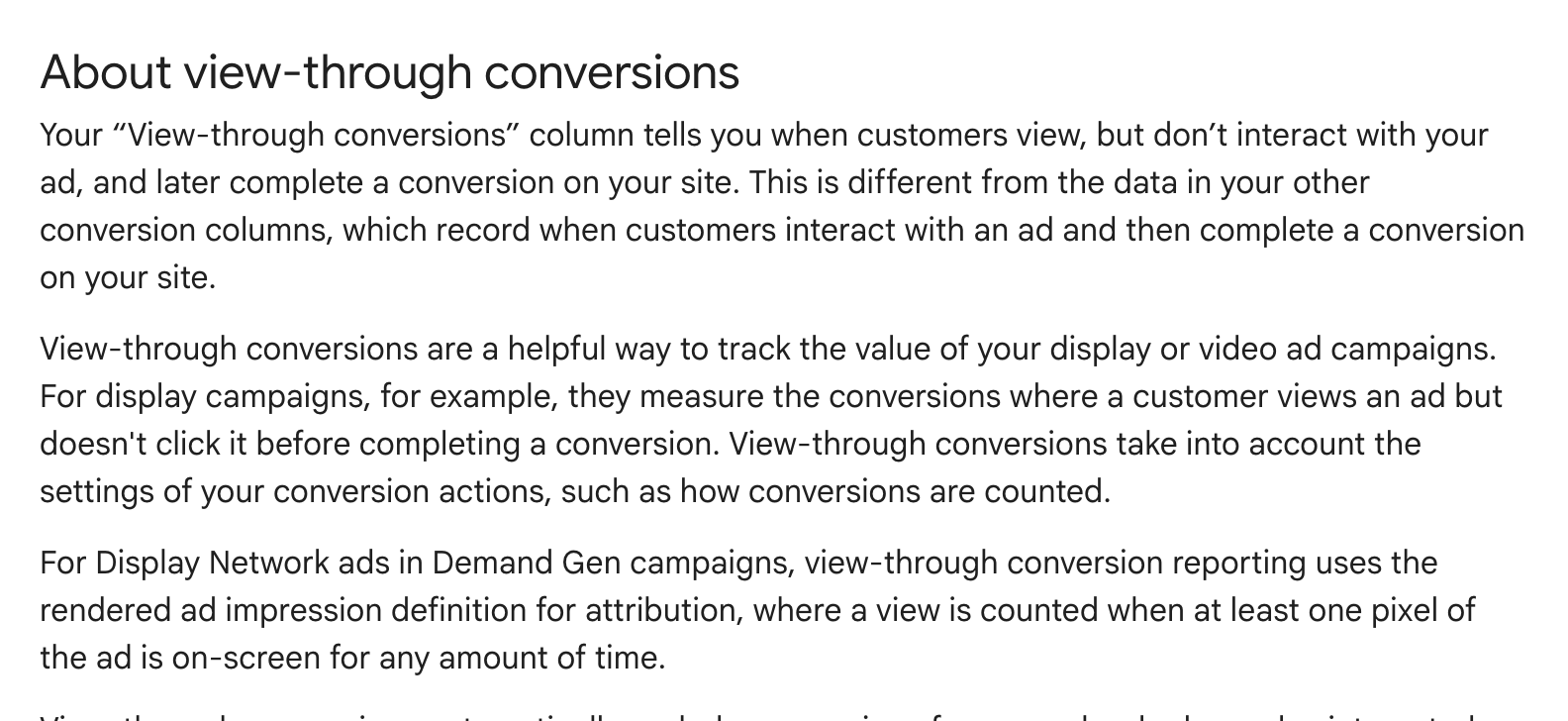
Google updated its Google Ads Help page Understand your conversion tracking data to say that view-through conversion reporting for Display Network ads in Demand Gen campaigns now counts a view when at least one pixel of the ad is on screen, for any amount of time. The PPC Times detected the change on November 20, 2026. The same paragraph previously described a view through Google's Active View standard: at least 50% of the ad on screen for at least 1 second. The page does not say when the new definition took effect.
How does Google Ads now count a view for Demand Gen view-through conversions?
The "About view-through conversions" section of the help page now says that, for Display Network ads in Demand Gen campaigns, view-through conversion reporting uses the "rendered ad impression definition for attribution". In practice, according to the page:
- What counts as a view: at least one pixel of the ad is on screen.
- How long: any amount of time.
- Scope: Display Network ads in Demand Gen campaigns.
Before the update, the paragraph covered Display Network ads in general and read differently:
- The last viewable impression got credit for the view-through conversion.
- An impression counted as viewable when at least 50% of the ad was on screen for at least 1 second, measured with Active View.
The new paragraph no longer says which impression gets credit, and the page no longer describes a viewability rule for Display Network ads outside Demand Gen. Further down, the same page still describes Active View for App Connect, where a Display Network view counts only when at least 50% of the ad is displayed for at least one continuous second.
The rest of the section is unchanged. View-through conversions still appear only in the "View-through conversions" and "All conversions" columns, not in "Conversions". They still exclude people who interacted with any of your other ads, and they still can't be reported from browsers that block cross-site cookies.
This is the second view definition change The PPC Times has found on Google Ads Help pages this month. On November 20, 2026 two pages about view-through conversion optimization for App campaigns moved to the same one-pixel standard.
Why it matters for advertisers
A one-pixel, any-duration view is a much lower bar than 50% for one second. More Demand Gen Display impressions could qualify, so more conversions could be matched to them as view-through conversions. Advertisers may see View-through conversions and All conversions rise for Demand Gen campaigns without any change in actual results.
Because view-through conversions stay out of the Conversions column, bidding on Conversions should not see them directly, based on what the page says. The effect is more likely to show in reports that use All conversions, in blended ROAS or CPA calculations that add view-through conversions back in, and in comparisons with third-party tools or analytics platforms that apply their own viewability rules.
The page does not say whether past data was restated, or whether the change applies to YouTube or Gmail placements in Demand Gen.
What to do now
- Check which of your reports, dashboards or client decks use All conversions or add view-through conversions for Demand Gen.
- Compare Demand Gen view-through conversion volume before and after November 20, 2026, segmented by network where you can, and annotate the date.
- If you report view-through conversions next to another tool's numbers, note the different view definitions when explaining gaps.
- Watch the Google Ads Help page for a dated announcement or further detail on scope.